
Back vs Lay Betting: Smart Essential Beginner Guide 2026
Back vs Lay Betting: Smart Essential Beginner Guide 2026
TL;DR
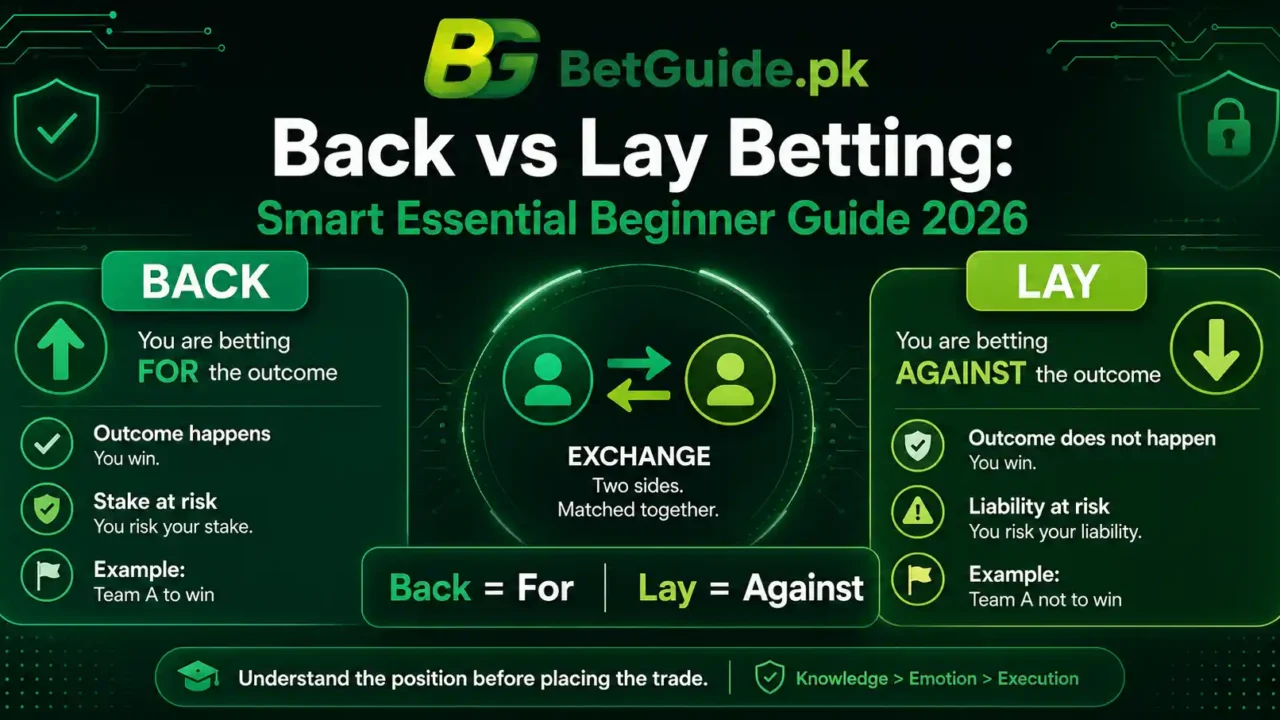
Back vs lay betting is the basic comparison every exchange beginner should understand before placing a real-money order. A back bet supports an outcome happening under the market rules. A lay bet takes the opposite position and wants that outcome not to happen. The key difference is risk: a back bet usually risks the stake, while a lay bet can create liability greater than the displayed lay stake.
On an exchange, the price also has to be matched. Clicking back or lay does not guarantee the full requested amount becomes active. Some or all of an order can remain unmatched when liquidity is insufficient. BetGuide.pk’s Exchange Betting Explained guide covers that wider structure; this article focuses on the back-versus-lay decision.
For simple arithmetic, back profit before commission is (decimal odds − 1) × stake. Lay liability is (lay odds − 1) × lay stake. If you lay Rs 1,000 at 3.00, the potential gross win is Rs 1,000 if the selection does not win, while liability is Rs 2,000 if it wins.
Understanding back vs lay betting does not create a winning system. It helps you read an exchange, calculate exposure, and avoid basic mistakes. If losses or repeated market decisions become difficult to control, use BetGuide.pk’s Responsible Gaming guide and step away before increasing exposure.
Context
What Is Back vs Lay Betting?
Back vs lay betting describes the two opposing sides of an exchange market. When you back a selection, you are saying that the named outcome will happen according to the settlement rules. When you lay it, you are saying that the same named outcome will not happen.
This is different from the familiar sportsbook model, where the customer normally backs an outcome and the operator takes the other side. On a betting exchange, users can take either side and orders are matched against available opposing money. Betfair’s exchange guidance describes back bets as supporting an outcome and lay bets as betting on that outcome not to happen.
The idea is simple. If the market is “Team A to win,” a back position wants Team A to be settled as the winner. A lay position wants Team A not to be settled as the winner. Always read the exact market rules because draws, ties, no-results, qualifications, handicaps, and other conditions can change how a selection is settled.

Why Back vs Lay Betting Confuses Beginners
The word “stake” creates most of the confusion. With a normal back bet, the stake is usually the amount you lose if the backed selection loses. With a lay bet, the displayed lay stake is generally the amount you stand to win before commission if the laid selection does not win; the amount you can lose is the liability.
That means a Rs 1,000 back stake and a Rs 1,000 lay stake do not necessarily expose the same amount. At lay odds of 1.50, Rs 1,000 of lay stake creates Rs 500 liability. At 3.00, it creates Rs 2,000 liability. At 5.00, it creates Rs 4,000 liability.
This is why BetGuide.pk’s Betting Basics and Risk Management guide should be read alongside exchange mechanics. Understanding odds is useful, but understanding the amount actually at risk is more important than memorizing button colors or market terminology.
Exchange Betting Is Not the Same as Every Betting Product
Back vs lay betting belongs to exchange-style markets. It should not be assumed to apply to every sportsbook, casino game, crash game, or platform that uses betting language.
A normal sportsbook can offer one set of operator prices without allowing customers to lay selections. Casino titles use their own rules and result systems. For example, the JeetBuzz game guide explains casino and game categories that should not be confused with an exchange order book.
Platform names can look similar while account systems and products differ. BetGuide.pk’s BetPro ID Pakistan guide explains the dealer-issued BetPro account model, while the BetPro vs BetPro360 guide shows why brand similarity does not prove identical logins, markets, or exchange features.
What Works: Back vs Lay Betting
1. Learn the Back Side First
A back bet is the easier side for most beginners because it resembles ordinary betting. You choose a selection and support it to happen. If the selection wins according to the market rules, the back position wins; if it loses, the back stake is normally lost.
Suppose you back Pakistan at decimal odds of 2.50 with Rs 1,000. The gross profit calculation is (2.50 − 1) × 1,000, which equals Rs 1,500. The gross return is Rs 2,500 because it includes the original Rs 1,000 stake plus Rs 1,500 profit.
If Pakistan does not win under that market’s settlement rules, the Rs 1,000 stake is normally the loss. Commission or other platform-specific rules can affect net returns, so treat the example as arithmetic rather than a promise about a particular platform.
2. Understand What a Lay Bet Really Means
A lay position takes the opposite side. If you lay Pakistan to win, you want Pakistan not to be settled as the winner under the rules of that market.
The important number is the liability. If you lay Rs 1,000 at odds of 2.50, the liability is (2.50 − 1) × 1,000 = Rs 1,500. If Pakistan does not win, your gross win is normally the Rs 1,000 lay stake before any applicable commission. If Pakistan wins, the Rs 1,500 liability is the amount at risk.
Back vs lay betting therefore changes the meaning of the number you type into the stake box. On the back side, it usually represents the amount at risk. On the lay side, it usually represents the other side’s stake that you are accepting, while the interface separately calculates your liability.
3. Use the Lay Liability Formula Every Time
The basic formula is simple: Lay liability = (lay odds − 1) × lay stake. A Rs 1,000 lay stake at 1.50 creates Rs 500 liability. At 2.00, liability is Rs 1,000. At 3.00, liability is Rs 2,000. At 5.00, liability is Rs 4,000.
Notice what changes as the odds rise. The amount you can win from the lay stake remains Rs 1,000 before commission, but the amount you may lose grows quickly. That asymmetry is the main reason beginners should never confirm a lay bet from the stake figure alone.
The platform should display liability before confirmation. Read that number. If it is larger than the amount you are willing to lose, reduce the lay stake or do not place the order.

4. Why Higher Lay Odds Increase Liability
The liability formula contains (odds − 1), so liability increases as lay odds increase when the lay stake stays the same. At odds of 1.20, a Rs 1,000 lay stake creates only Rs 200 liability. At 10.00, the same lay stake creates Rs 9,000 liability. The potential gross win remains Rs 1,000 if the laid selection does not win.
This is one of the most important back vs lay betting lessons. High odds can make the potential lay loss much larger than the amount displayed as the lay stake. Never assume that a small-looking stake means a small risk.
5. Understand Back Price and Lay Price
Exchange markets normally show prices available to back and prices available to lay. They are two sides of the same market, but they may not be identical.
The best available back price is the highest price currently available for someone wanting to back. The best available lay price is the lowest price currently available for someone wanting to lay, subject to the exchange interface and available money. The gap between them is often called the spread.
A narrow spread can indicate active competition and better market depth, while a wider spread may appear in thinner markets. However, a narrow spread does not make an outcome safer or more predictable. It only tells you something about the order book and available prices.
6. Know What “Matched” Means
An exchange order only becomes active to the extent that another participant takes the opposing side at an available price. That is what “matched” means.
Suppose you request a Rs 1,000 back bet at 2.20, but only Rs 600 is available at that price. The exchange may match Rs 600 and leave Rs 400 unmatched. Only the matched amount creates the confirmed position at that stage.
If the selection wins and only Rs 600 was matched at 2.20, the gross profit on that matched portion is (2.20 − 1) × 600 = Rs 720, before any applicable commission. The unmatched Rs 400 does not generate the same exposure unless it later matches.
7. Partially Matched Is Not Fully Matched
A partially matched order contains two pieces: an active matched amount and a remaining unmatched amount. Beginners sometimes look only at the original requested stake and assume the whole amount is active.
Always check the matched amount, unmatched amount, and average matched price. If you cancel the remaining unmatched portion, confirm that the platform actually reports it as cancelled.
This matters on both sides of back vs lay betting. A partially matched lay order creates liability only on the matched portion, although the remaining amount can create additional liability if it later matches.

8. Liquidity Determines Whether Orders Can Match
Liquidity is the amount of opposing money available at different prices. A highly active market can have substantial money waiting on both the back and lay sides, while a thin market may have little available at the price you want.
Low liquidity can leave an order unmatched, partially matched, or matched across different prices. It can also make visible prices change quickly when even modest amounts are added or removed.
BetGuide.pk’s Exchange Betting Explained guide covers liquidity and order status in more detail. For this article, the key point is that a price shown on screen is not the same thing as a guaranteed fully matched position.
9. Cricket Example: Backing a Team
Imagine a cricket match market where Pakistan is offered at 2.40 and you choose to back Pakistan with Rs 500. If the market rules settle Pakistan as the winner, gross profit is (2.40 − 1) × 500 = Rs 700, before any commission.
If Pakistan is not settled as the winner, the usual back loss is the Rs 500 stake. That is the straightforward side of back vs lay betting.
Do not extend the example to every cricket market. Match odds, tournament winner, top batter, innings runs, and other markets have different settlement conditions. Always read the market name and rules before assuming what “win” means.
10. Cricket Example: Laying a Team
Now imagine laying Pakistan at 2.40 for a lay stake of Rs 500. The liability is (2.40 − 1) × 500 = Rs 700.
If Pakistan does not win under that market’s rules, the gross win is Rs 500 before any applicable commission. If Pakistan wins, the Rs 700 liability is lost.
The same selection and same odds therefore create opposite positions. The backer risks Rs 500 to seek Rs 700 gross profit. The layer risks Rs 700 to seek Rs 500 gross profit. Neither side is automatically “better”; they simply express opposite views with different exposure.
11. Football Example: Laying a Team to Win
Consider a three-way football match-winner market containing Home, Draw, and Away. If you lay the home team to win, your lay position succeeds if the home team is not settled as the winner, which usually means a draw or away win in that specific market.
Do not carry that assumption into every football market. “To qualify,” “draw no bet,” handicaps, correct score, and other markets settle differently. Back vs lay betting always follows the rules of the exact selection you clicked.
This is why educational understanding must come before speed. A familiar team name does not tell you which settlement condition the market represents.
12. Commission Changes Net Profit, Not the Core Position
Some betting exchanges charge commission on net winnings according to their own terms. The rate and method can vary, so this article does not assume one universal percentage.
The back-versus-lay formulas above show gross figures before commission. If commission applies to a winning market, the amount you actually keep may be lower than the gross calculation.
Commission should therefore be included when comparing possible returns, but it does not change the basic meaning of the position. Back still supports the outcome; lay still opposes it; liability remains the amount at risk if the laid selection wins.
13. Do Not Treat Price Movement as a Prediction
Exchange prices move because orders are added, matched, cancelled, and repriced, while new information and changing demand can affect the market. A movement from 2.20 to 2.00 does not guarantee that the selection is now more likely to win in a way that produces profit.
The market may continue moving, reverse, suspend, or reopen at a different price. Chasing movement without understanding exposure can turn an educational concept into impulsive betting.
Use prices to understand what is available, not as a promise about the result. BetGuide.pk’s Betting Basics and Risk Management guide is the better place for broader probability and risk principles.
14. Backing and Laying the Same Selection Is Not Guaranteed Profit
An exchange may allow a user to back and later lay the same selection, or lay and later back it. That can change exposure, but it does not guarantee profit.
The second order must still match at the required price and amount. Commission, price movement, partial matching, and market suspension can affect the final position. If the intended second order does not match, the user can remain exposed.
Beginners should learn one position at a time before experimenting with multiple orders. Understanding the mechanics is more valuable than copying a “green up,” “hedge,” or trading formula from someone promising guaranteed returns.
15. Read the Market Before the Odds
A price has meaning only inside a specific market. Odds of 2.00 on “Team A to win” are not interchangeable with 2.00 on “Team A to qualify,” “over 2.5 goals,” or “player to score.” Before using back vs lay betting, read the event, market name, selection, settlement rules, and any special conditions. Only then consider the price and stake.
This order prevents a common mistake: correctly calculating liability on the wrong market. Perfect arithmetic cannot repair a misunderstanding about what the selection actually represents.
16. Roman Urdu: Back Aur Lay Betting Kya Hai?
Back ka matlab hai ke aap kisi outcome ke hone ko support kar rahe hain. Misal ke taur par agar aap Pakistan ko back karte hain, to aap chahte hain ke market rules ke mutabiq Pakistan winner settle ho.
Lay ka matlab usi selection ke against position lena hai. Agar aap Pakistan ko lay karte hain, to aap chahte hain ke Pakistan winner settle na ho. Lay bet mein sirf stake dekhna kaafi nahin; liability bhi check karna zaroori hai.
Formula yaad rakhein: liability = (lay odds − 1) × lay stake. Agar lay stake Rs 1,000 aur odds 3.00 hon, liability Rs 2,000 hogi. Confirm karne se pehle matched amount, liability, aur market rules dobara check karein.
Trade-offs
Back Bets Are Simpler, but Simpler Does Not Mean Safer
Back bets are easier for beginners because the stake usually equals the amount at risk. The profit calculation is also familiar, especially for anyone who has used decimal sportsbook odds.
The trade-off is that simple mechanics can encourage people to skip market rules or stake planning. A back bet can still lose the entire stake, and repeated small back bets can produce a large total loss. Choose the back side because it matches your intended market position, not because it feels harmless.
Lay Bets Add Flexibility but Require Stronger Exposure Checks
Lay betting gives exchange users a position that ordinary sportsbook customers may not have: taking the side that a selected outcome will not happen. That can make markets more flexible to read and trade.
The trade-off is liability. At high lay odds, the potential loss can become several times larger than the lay stake. A user who looks only at the possible gross win can underestimate the real exposure. For beginners, the safest sequence is liability first, market rules second, matched amount third, and only then the possible win.
Better Prices vs Matching Certainty
An exchange may let you request a more attractive price than the one currently available. The trade-off is that nobody may accept it.
Taking an available price can improve matching certainty but may offer a less attractive number. Requesting a different price can improve the potential value if it matches, but the order can remain unmatched or only partly matched.
There is no universal correct choice. The educational point is that the requested price and the matched price are not always the same thing.
Next Steps
A 60-Second Back vs Lay Betting Check
Before confirming an exchange order, identify the exact market and selection. Say the position in plain language: “I am backing this outcome to happen” or “I am laying this outcome not to happen.” If you cannot say which side you are taking, stop.
Next, calculate the exposure. For a back bet, check the stake and possible gross profit. For a lay bet, calculate (odds − 1) × lay stake and compare it with the liability displayed by the platform.
Then check matching. Confirm how much money is available at the requested price and, after submitting, verify the matched and unmatched amounts. Do not assume that clicking the button activated the whole order.
Finally, decide whether the amount fits a pre-set discretionary budget. Understanding back vs lay betting does not remove the possibility of losing money. If the decision is being driven by loss chasing or pressure, use the Responsible Gaming guide instead of increasing exposure.
Is Lay Betting Riskier Than Back Betting?
Not automatically, but lay risk is easier to misunderstand because liability can be greater than the lay stake. Compare the maximum possible loss rather than comparing only the stake boxes. A small lay stake at high odds can create more exposure than a larger-looking back stake.
Why Is My Lay Liability Bigger Than My Stake?
Because the layer must cover the backer’s potential profit if the laid selection wins. With decimal odds, liability is (lay odds − 1) × lay stake. As the odds rise, liability increases for the same lay stake.
Can Back vs Lay Betting Guarantee a Profit?
No. Understanding both sides helps you calculate positions and read an exchange, but it does not predict results or guarantee that later orders will match at the price you need. Price movement, partial matching, commission, settlement rules, and market suspension can all affect the final outcome.
References
BetGuide.pk’s Exchange Betting Explained guide provides the broader framework for back, lay, liability, liquidity, matched and unmatched orders, commission, and market suspension. This article narrows that hub into worked back-versus-lay examples and beginner exposure checks.
Betfair’s official exchange guidance defines backing as supporting an outcome and laying as taking the position that it will not happen. Its glossary defines liability as the amount at risk in the worst-case lay scenario and liquidity as money available to match at relevant prices.
The calculations here are gross educational examples. They do not assume a fixed commission rate because commission rules can vary by platform and current terms.
BetGuide.pk’s Betting Basics and Risk Management guide covers odds, probability, bankroll, and risk concepts. The Responsible Gaming guide covers limits, loss chasing, breaks, and safer-use principles.
Conclusion
Learn the Exchange Before You Use It
The easiest way to remember back vs lay betting is to separate opinion from exposure. Back means you want the selection to happen; lay means you want it not to happen. After that, check the stake, liability, matched amount, market rules, and any applicable commission.
Do not move to complex exchange tactics until those basics are clear. If liability surprises you, stop. If an order remains unmatched, check its status. If you cannot explain settlement, read the rules before confirming another position.
For the complete market structure, continue with BetGuide.pk’s Exchange Betting Explained guide. For general odds and risk fundamentals, use the Betting Basics and Risk Management guide.
If you later use an exchange-style platform, remember that account models and features differ. These checks matter even on a familiar interface. Use the relevant BetGuide.pk platform guide rather than assuming every service uses the same interface or registration flow.
BetGuide.pk provides independent educational information, not betting or financial advice. No back, lay, trading, hedging, signal, or pricing method can guarantee profit. Use only discretionary money, set limits before placing a position, and stop when betting interferes with essential spending or calm decision-making.