
BPExch Deposit: Safe Essential Payments Guide 2026
BPExch Deposit: Safe Essential Payments Guide 2026
TL;DR
A BPExch deposit should begin with verification, not with speed. Before sending money, confirm that you are using the current account route, that the recipient details match the instructions for your account, and that the amount and payment reference are correct. BetGuide.pk does not publish a universal BPExch deposit minimum, permanent recipient number, fixed processing time, or guaranteed payment method because those details can vary and may change.
If you already use BPExch, keep your issued login credentials separate from payment information. A deposit request should never require you to disclose your password, OTP, wallet PIN, banking PIN, email password, or device unlock code. If someone changes a recipient number, bank account, wallet, QR code, or payment link unexpectedly, stop and verify the new instruction before transferring funds.
This guide is for adults aged 18 and over. Real-money betting carries financial risk. Set a spending limit before you deposit, never borrow to fund betting, and use BetGuide.pk’s responsible gaming guidance if betting is starting to affect your finances, mood, work, or relationships.
Context
What a BPExch deposit means
A BPExch deposit is the funding step that adds money to the account environment you already access with your issued credentials. It is different from creating an account, logging in, downloading an Android app, or understanding a wallet label. If you are still trying to obtain an account, start with the BPExch registration guide instead of treating a payment request as registration.
The current BPExch Pakistan guide explains that BetGuide.pk does not operate BPExch, create accounts, hold customer balances, process deposits or withdrawals, or guarantee platform outcomes. That distinction matters when dealing with payment instructions. BetGuide can help you check the logic and safety of a deposit process, but it cannot confirm an account-specific recipient or transaction from outside your own verified route.
People often search for a simple answer such as “where do I send a BPExch deposit?” The safer answer is not a permanent number copied from a blog, screenshot, forwarded chat, or old message. The safer answer is to verify the current instructions that apply to your account immediately before sending money.
Deposit, wallet, and account access are different
A deposit is a transaction. A wallet can refer to a balance area, payment interface, or related access tool. Login credentials are the username and password used to access the account. Mixing these ideas creates avoidable risk because a person may assume that any page using the word “wallet” is automatically the correct place to send money.
For wallet terminology and access, use the dedicated BPExch Wallet guide. That article explains the difference between wallet identity, account access, login, apps, and payment instructions. This guide stays focused on the deposit decision itself: checking the route, recipient, amount, reference, evidence, and post-payment status.
The separation also helps when troubleshooting. A failed login is not automatically a deposit problem. A visible balance that has not changed is not automatically proof that money is lost. A payment confirmation from your bank or wallet is evidence that a transfer was initiated or completed on that payment service, but it does not by itself prove how the receiving account has been credited inside BPExch.
Why payment instructions deserve extra verification
Payment fraud often succeeds by creating urgency. A message may say that a number has changed, an account is temporarily unavailable, a deposit must be sent immediately, or a special recipient should be used to avoid delay. The National CERT of Pakistan warns that phishing commonly relies on urgency, deceptive links, impersonation, and requests for confidential information.
The State Bank of Pakistan has also repeatedly warned users about social-engineering fraud and messages that impersonate trusted institutions. The practical lesson for a BPExch deposit is straightforward: familiarity with a name, logo, WhatsApp profile, or previous conversation is not enough. Verify the current instruction before transferring value.
Verification comes first. A safe deposit process should become clearer as you check it. If each question produces more pressure, more secrecy, a new recipient, a new link, or a request for credentials, that is a reason to stop rather than rush.
What Works
BPExch Deposit: Verify the Route Before Paying
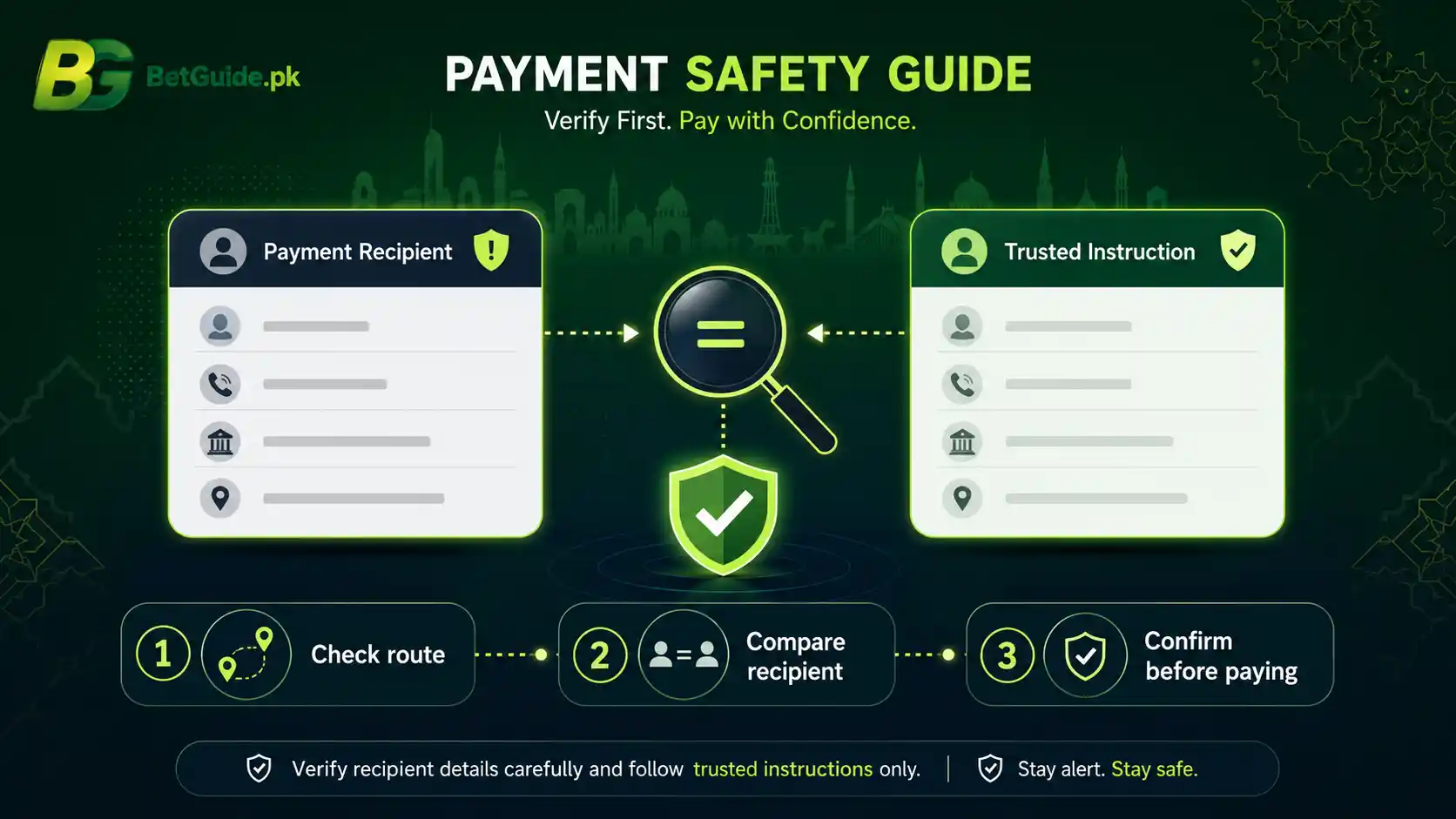
Start from the account or provider route you already recognize and have previously verified. Do not begin with a random search result, sponsored social post, forwarded APK message, copied Telegram profile, or shortened payment link. If you are unsure which platform address belongs to the account ecosystem covered by BetGuide, review the BPExch Pakistan access guide before entering credentials or following payment instructions.
Verification is most important when the payment destination has changed. A new wallet number, bank recipient, QR code, or payment page may be legitimate for a particular account, but BetGuide cannot confirm that from a generic public article. Treat a change as something to recheck, not something to accept automatically.
Do not rely on a screenshot of an old deposit instruction. Screenshots are easy to forward, edit, crop, or reuse after details have changed. Read the current instruction from the route you trust and compare the recipient carefully before confirming the transfer.
Confirm the account context first
Before funding anything, make sure you understand which account you are trying to fund. If you have multiple usernames, old accounts, or messages from different providers, verify the intended account first. Sending money while the account identity is unclear creates a problem that is harder to untangle afterward.
If you do not yet have an issued account, do not assume that a payment is the normal first step. The BPExch registration guide explains the account model covered by BetGuide and separates registration from login. Use that guidance before responding to an unsolicited request for money connected with “activation,” “verification,” or “account opening.”
If you already have the correct account, sign in only through a confirmed access route and check that the displayed account details are the ones you expect. Do not share the password with anyone who says they need it to confirm a deposit.
Check the recipient carefully
Recipient verification is one of the most important parts of a BPExch deposit. Compare the name, number, account identifier, QR destination, or other recipient information shown in your current instruction with what appears on your payment screen before you authorize the transfer.
Small differences matter. A changed digit, unfamiliar name, different bank, new wallet identifier, or redirected payment page should trigger another check. Do not let a countdown, bonus claim, “last slot,” support queue, or alleged maintenance issue pressure you into ignoring a mismatch.
Where your payment service shows a recipient name before confirmation, read it. Do not assume that a familiar profile picture or contact name proves the financial destination is correct. The payment screen is an additional verification layer, not a substitute for confirming the instruction itself.
Confirm the amount and reference
Use the amount that applies to your current account instruction. BetGuide.pk does not publish a universal minimum or maximum BPExch deposit because the current production guidance does not support one number for every account and provider.
If the instruction asks for a payment reference, transaction note, account identifier, or other non-secret information, check it for accuracy before sending. Do not invent a reference or reuse one from an old transaction unless the current instruction clearly tells you to do so.
Never include a password, OTP, wallet PIN, banking PIN, email password, or recovery code in a payment note. Those are authentication secrets, not transaction references. If anyone asks you to send such information in chat or attach it to payment evidence, stop.
Set your budget before opening the payment app
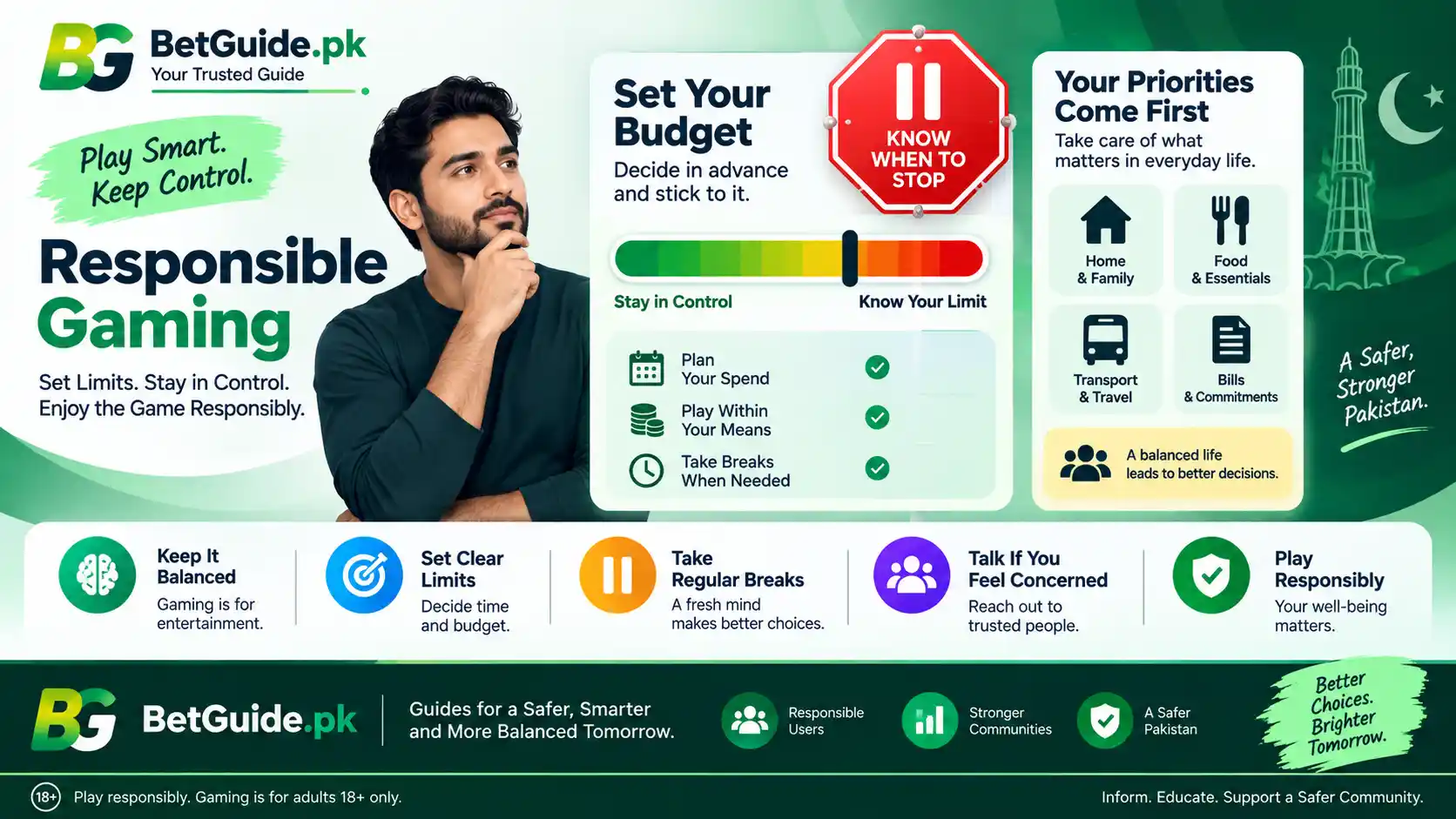
A safer deposit decision starts before the transfer screen. Decide how much money you can afford to lose without affecting rent, food, transport, bills, debt payments, savings, or family responsibilities. That amount should be your ceiling, not a target you increase after a losing session.
Do not borrow to make a deposit. Do not use money that has another purpose. Do not treat a deposit as an investment or as a guaranteed route to profit. Betting outcomes are uncertain, and a successful deposit only means money has been transferred into a betting environment; it says nothing about future winnings or withdrawals.
If you feel pressure to recover previous losses, delay the deposit. The responsible gaming guide can help you think about limits, breaks, and warning signs before another payment is made.
Keep authentication secrets out of payment conversations
A legitimate payment discussion does not require someone to know your existing password, OTP, wallet PIN, banking PIN, email password, or device unlock code. Keep those details private even if the person contacting you uses a familiar logo, account name, or support language.
The State Bank of Pakistan advises consumers not to share personal or financial credentials in response to fraudulent calls and messages. That principle applies strongly when a payment conversation moves from ordinary transaction details into authentication secrets.
If an OTP arrives while you are talking to someone, read what the OTP message says before doing anything. Do not forward the code or read it aloud to a stranger. An OTP may authorize an action on your bank, wallet, email, or another service, and sharing it can give control to someone else.
Use your own payment confirmation as evidence
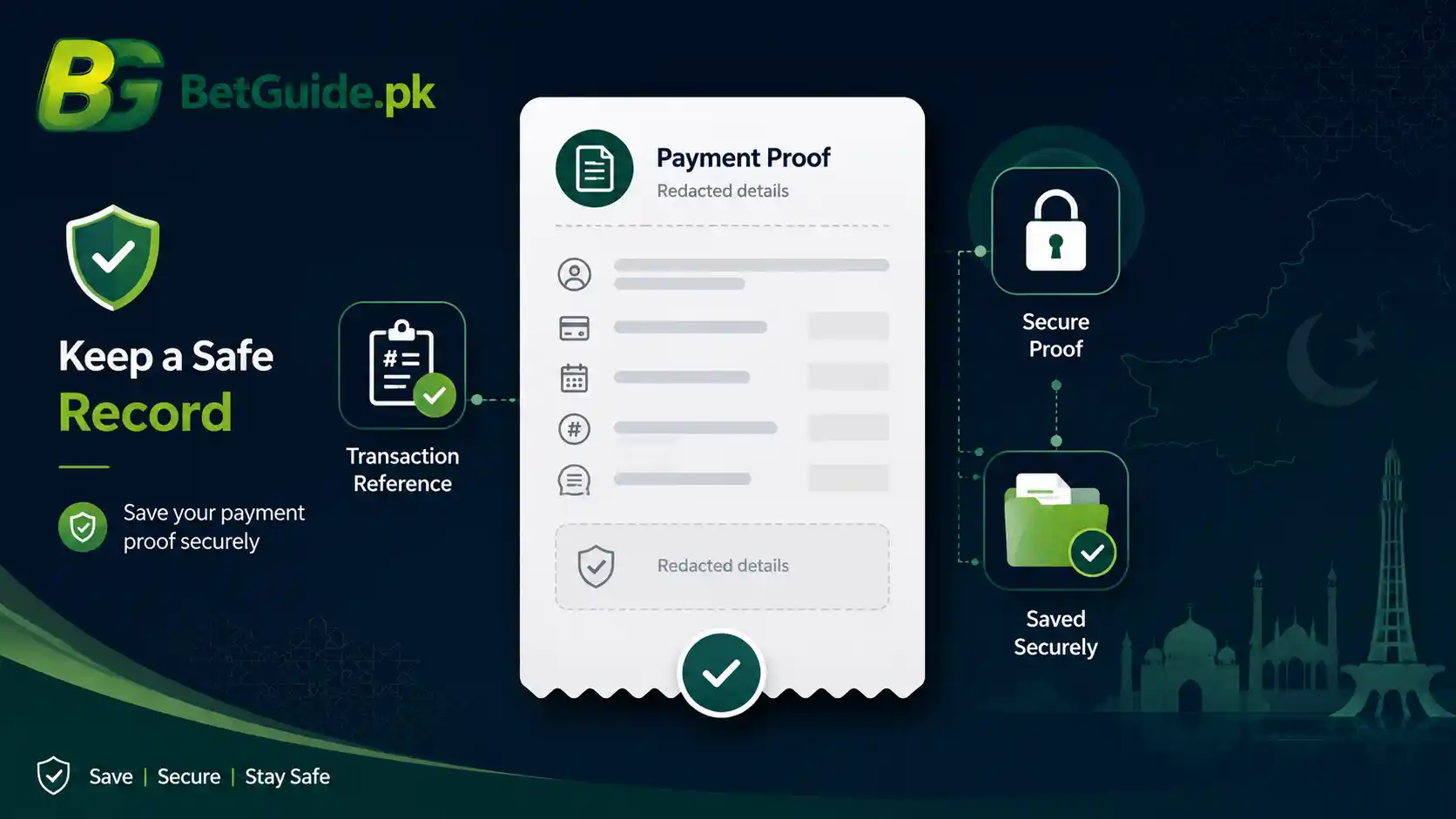
After sending money, save the transaction reference, confirmation message, receipt, or other evidence provided by your payment service. Keep it in a form that lets you identify the date, amount, recipient, and transaction reference without exposing unrelated financial information.
If you later need to show proof, share only what is necessary through the verified route. Redact unrelated balances, account numbers, personal messages, or other private data where possible. A full banking screenshot can reveal much more information than a payment query requires.
Do not edit the receipt to make a failed transfer appear successful. Likewise, do not trust a screenshot sent by another person as proof that your own account was funded. Use your own records and the status visible in the account you control.
Check the status without immediately paying again
If a transfer has left your payment account but the BPExch balance does not appear to reflect it, do not automatically repeat the deposit. A second payment can turn one unresolved transaction into two.
First confirm the transaction status in your bank or wallet, the amount, recipient, and reference. Then check the account you intended to fund. If the information is consistent but the expected balance is still not visible, use the original verified support/provider route with a concise description and your transaction reference.
Avoid sending repeated messages to multiple unrelated contacts. That can expose the same payment information to people who do not need it and makes it harder to maintain one clear record of what happened.
Treat changed payment instructions as a fresh risk check
A recipient change deserves more attention than a routine repeat deposit. If someone says the previous number is closed, a bank is unavailable, a wallet is full, or payments have moved to another destination, verify the change independently through the trusted route you already use.
Do not verify a suspicious message by calling only the number contained inside that same suspicious message. That merely returns you to the source of the claim. Use a contact path or account route that you had already established before the unexpected change.
If the sender becomes angry, threatens account closure, promises a special reward, or insists that verification will cause you to “miss” an opportunity, do not let the pressure set your pace. Financial instructions should survive reasonable checking.
Be careful with QR codes and payment links
A QR code can simplify payment, but it can also hide the destination until you scan it. Before authorizing a QR payment, check the recipient information shown by your payment app and compare it with the current instruction.
The same applies to payment links. Look at the actual destination before entering financial information. A page that copies branding does not prove ownership. Phishing pages can imitate familiar layouts while collecting credentials or redirecting payments.
Do not install an app or APK simply because a payment message says it is required. If your question is specifically about Android access, use the BPExch Live APK guide after it is live, rather than downloading files sent inside a payment conversation.
Understand what a successful transfer does and does not prove
A bank or wallet confirmation proves something about that payment service: for example, that a transaction was submitted, debited, or credited according to the status it displays. It does not automatically prove that the correct BPExch account received credit, that an offer is valid, or that a future withdrawal will succeed.
Likewise, seeing funds inside an account does not remove betting risk. A deposit is not a recommendation to place a bet, and it is not evidence that a strategy will be profitable.
Separate payment verification from betting decisions. First establish that the money went where intended. Then, if you choose to bet, make that decision within the limit you set before the deposit.
BPExch deposit withdrawal searches need two different checks
People sometimes search for “bpexch deposit withdrawal” as though funding and cashing out are one process. They are related financial actions, but they should not be treated as identical.
For a deposit, the key checks are the account context, current recipient, amount, reference, payment confirmation, and resulting balance. A withdrawal has different account-specific conditions and destination checks. BetGuide does not promise that the same payment method, limit, recipient, or timing applies in both directions.
If your real issue is taking money out rather than funding the account, use guidance that is specifically about withdrawals instead of following deposit instructions backward.
Use one clear record for support
If a deposit needs investigation, prepare a short factual record: the account you intended to fund, the date, amount, payment service used, recipient shown, transaction reference, and the status shown by your payment service. Share only the details necessary to investigate the transaction.
Avoid long emotional messages, repeated screenshots, multiple versions of the story, or claims you cannot prove. A clear timeline makes it easier to understand what happened and reduces the chance that you accidentally expose sensitive data.
Keep copies of relevant messages if payment instructions changed. Do not delete the original instruction just because a new recipient was later provided. The sequence may matter when you are trying to understand a mismatch.
Know when to stop
Stop before paying if the account identity is unclear, the recipient does not match, the instruction comes from an unverified contact, or someone asks for authentication secrets. Stop after paying if the transaction is unresolved and you are being pressured to send another deposit immediately.
Also stop if the deposit amount is moving beyond the budget you set. The strongest safety control is sometimes not another technical check, but deciding not to transfer more money.
A pause is especially important when someone promises guaranteed winnings, fixed results, recovery of previous losses, or a special return that depends on depositing now. Those claims do not reduce financial risk.
Trade-offs
Convenience versus verification
Repeat payments can feel routine, which makes it tempting to skip checks. The trade-off is that faster action can increase exposure to changed recipients, old instructions, impersonation, or simple typing mistakes.
You do not need to treat every deposit as a forensic investigation. You do need to verify the critical details: account context, recipient, amount, reference, and payment confirmation. If something important has changed, slow down enough to understand why.
The extra minute spent checking a recipient is usually less costly than trying to recover a transfer sent to the wrong destination.
Public instructions versus account-specific instructions
A public guide is useful for explaining what to verify, but it is a poor place to publish a permanent recipient number, universal minimum, fixed processing promise, or guaranteed method when those details are not independently confirmed as universal.
This may feel less convenient than a page that gives one confident number for everyone. The benefit is that it avoids turning old or account-specific information into a misleading instruction.
BetGuide therefore focuses on a verification framework. The current account route must supply the live operational details; the guide helps you evaluate those details safely.
Speed versus evidence
When a balance is not updated immediately, sending another payment may feel like the quickest way to solve the problem. It can also create duplicate transactions and make the situation harder to reconcile.
Keeping one receipt, one transaction reference, and one clear timeline gives you a better basis for follow-up. It also protects you from people who ask you to “prove” payment by sharing excessive banking information.
Do not confuse patience with passivity. Check the payment status, preserve evidence, and use the verified route. The point is to act methodically instead of multiplying transactions.
Access convenience versus financial risk
Being able to fund an account easily can reduce friction, but lower friction does not make betting safer. A deposit moves spendable money into an environment where losses are possible.
Set limits before convenience takes over. If a payment method makes it too easy to exceed your planned amount, use a stronger personal control: a lower transfer limit, a pause, or no deposit.
Financial risk should remain visible even when the technical process works perfectly.
Next Steps
Before your next BPExch deposit
Use a simple sequence. Confirm the account you intend to fund. Open the route you already trust. Read the current payment instruction. Compare the recipient on your payment screen. Check the amount and any non-secret reference. Keep passwords, OTPs and PINs private. Then decide whether the deposit still fits the limit you set.
If any one of those checks fails, do not compensate by guessing. Go back to the verified source and clarify the mismatch.
For broader platform access, domains, login, and account relationship information, return to the BPExch Pakistan guide. For account creation, use the BPExch registration guide. For wallet identity and access, use the BPExch Wallet guide.
After you pay
Keep the payment confirmation and transaction reference. Check the intended account rather than relying on a message from another person. If the expected balance is not visible, verify the payment status before doing anything else.
Do not send the same amount again simply because someone says the first payment is “stuck.” Do not pay an unexpected extra fee merely because a message claims it will release, verify, or unlock the first transaction.
If you believe you have been targeted by a payment scam, preserve the evidence and review BetGuide.pk’s betting payment scams guide for practical warning signs and next steps.
Micro-FAQs
Is there one BPExch deposit minimum for every account?
BetGuide.pk does not publish one universal BPExch deposit minimum because the current verified guidance does not establish a single amount for every account or provider. Check the current instruction that applies to your own account before transferring money.
Which payment method should I use for a BPExch deposit in Pakistan?
Use a method currently shown or confirmed for your account through the route you trust. Do not assume that a method mentioned in an old article, screenshot, group message, or another user’s account is permanently available to you.
What should I do if my BPExch deposit is not showing?
First check the payment status, recipient, amount, and transaction reference. Do not immediately repeat the deposit. If those details are correct but the expected balance is still not visible, use the original verified support/provider route and share only the information necessary to investigate.
References
BetGuide.pk’s BPExch Pakistan guide is the primary current source for the platform relationship, confirmed access context, dealer-based account model, credential safety, and the statement that payment methods, limits, and processing conditions can depend on the account and provider.
The BPExch Wallet guide provides the separate wallet/access context used in this article, while the BPExch registration guide covers account creation rather than deposits.
For financial-security context, the State Bank of Pakistan digital-payment security guidance covers transaction alerts and payment security, while Pakistan National CERT phishing guidance describes deceptive links, impersonation, urgency, and attempts to obtain confidential information.
Conclusion
If you are preparing a BPExch deposit, verify first and pay second. Confirm the account context, current recipient, amount, and reference before authorizing a transfer, and keep your password, OTP, banking PIN, wallet PIN, email password, and recovery codes private.
Use the BPExch Pakistan guide when you need to recheck the platform access route, and use the responsible gaming guide before depositing again if spending is starting to move beyond the limit you planned.
When uncertainty remains, keep money where it is until the payment route, recipient, and account purpose are clear.
Bet only if you are 18 or older, and only with money you can afford to lose. A safe deposit process reduces avoidable payment risk; it cannot make betting outcomes predictable or profitable.